Information for Peptide: VVPPLDEDGR from CDK2_HUMAN
1. Biological Peptide
1.1 Native Sequence
K.VVPPLDEDGR.S
1.2 Peptide Properties
| Start | Stop | MW | m/z for 2+ | m/z for 3+ | pI |
|---|---|---|---|---|---|
| 251 | 260 | 1095.56 | 548.79 | 366.19 | 4.03 |
1.3 Fragment Ion Table
| AA | b Ion Series | b Ion Mass | y Ion Series | y Ion Mass |
|---|---|---|---|---|
| V | b | y | ||
| V | b | y | ||
| P | b | y | ||
| P | b | y | ||
| L | b | y | ||
| D | b | y | ||
| E | b | y | ||
| D | b | y | ||
| G | b | y | ||
| R | b | y |
2. Synthetic Peptide
2.1 Synthetic (Internal Standard) Peptide Sequence
VVPPLDEDAR (Modification: Amino acid switch from G9 to A )
2.2 Peptide Properties
| MW | m/z for 2+ | m/z for 3+ | pI |
|---|---|---|---|
| 1109.57 | 555.79 | 370.87 | 4.03 |
2.3 Fragment Ion Table
| AA | b Ion Series | b Ion Mass | y Ion Series | y Ion Mass |
|---|---|---|---|---|
| V | b | y | ||
| V | b | y | ||
| P | b | y | ||
| P | b | y | ||
| L | b | y | ||
| D | b | y | ||
| E | b | y | ||
| D | b | y | ||
| A | b | y | ||
| R | b | y |
2.4 Peptide Synthesis Report
 Click to view/download synthesis report for VVPPLDEDGR
2.5 QqQ MS/MS
Transition Table:
| Transition | m/z of Transition | Collision Energy |
|---|---|---|
| y9 | 1011.51114 | 11.0 |
| y8 | 912.44273 | 16.0 |
| y7 | 815.38996 | 25.0 |
| y6 | 718.3372 | 33.0 |
| y5 | 605.25314 | 28.0 |
| y4 | 490.22619 | 29.0 |
| y3 | 361.1836 | 31.0 |
2.6 Calibration Curve of Standard
Description: A dilution series was done on the internal standard peptide from 50 Fmol to 0.1 fmol. Peptide detection was possible to 0.1 fmol.
Experiment Description: Cells from Melanoma cell line were lysed in 8M urea/100mM Ammonium bicarbonate buffer. The equivalent of 200,000 cells were loaded onto an SDS gel.
2.7 LC-MRM Analysis of Biological and Standard Peptides Illustrates Elution Times

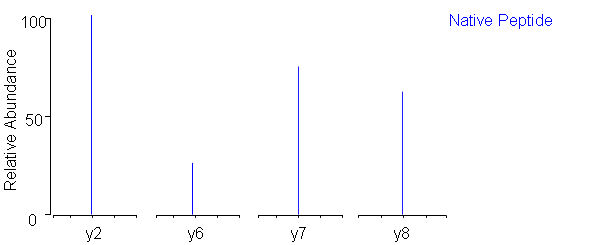
2.8 Pseudo MS/MS Comparison of Transition Patterns for Biological/Standard Peptides