

Information for Peptide: VGDYGSLSGR from CATZ_HUMAN
1. Biological Peptide
1.1 Native Sequence
R.VGDYGSLSGR.E
1.2 Peptide Properties
| Start | Stop | MW | m/z for 2+ | m/z for 3+ | pI |
|---|---|---|---|---|---|
| 190 | 199 | 1009.48 | 505.75 | 337.5 | 5.81 |
1.3 Fragment Ion Table
| AA | b Ion Series | b Ion Mass | y Ion Series | y Ion Mass |
|---|---|---|---|---|
| V | b | y | ||
| G | b | y | ||
| D | b | y | ||
| Y | b | y | ||
| G | b | y | ||
| S | b | y | ||
| L | b | y | ||
| S | b | y | ||
| G | b | y | ||
| R | b | y |
2. Synthetic Peptide
2.1 Synthetic (Internal Standard) Peptide Sequence
VGDYGSLSAR (Modification: Amino acid switch from G8 to A )
2.2 Peptide Properties
| MW | m/z for 2+ | m/z for 3+ | pI |
|---|---|---|---|
| 1023.5 | 512.76 | 342.17 | 5.81 |
2.3 Fragment Ion Table
| AA | b Ion Series | b Ion Mass | y Ion Series | y Ion Mass |
|---|---|---|---|---|
| V | b | y | ||
| G | b | y | ||
| D | b | y | ||
| Y | b | y | ||
| G | b | y | ||
| S | b | y | ||
| L | b | y | ||
| S | b | y | ||
| A | b | y | ||
| R | b | y |
2.4 Peptide Synthesis Report
 Click to view/download synthesis report for VGDYGSLSGR
2.5 QqQ MS/MS
Transition Table:
| Transition | m/z of Transition | Collision Energy |
|---|---|---|
| y8 | 868.41651 | 20.0 |
| y7 | 753.38957 | 20.0 |
| y6 | 590.32624 | 20.0 |
| y5 | 533.30478 | 20.0 |
| y4 | 446.27275 | 20.0 |
2.6 Calibration Curve of Standard
Description: A dilution series was done on the internal standard peptide from 50 Fmol to 0.1 fmol. Peptide detection was possible to 0.1 fmol.
Experiment Description: Control urine was processed via ultrafiltration according to Moffitt Proteomics protocol and subjected to in-solution digestion with trypsin, following thermal denaturation, reduction, and alkylation.
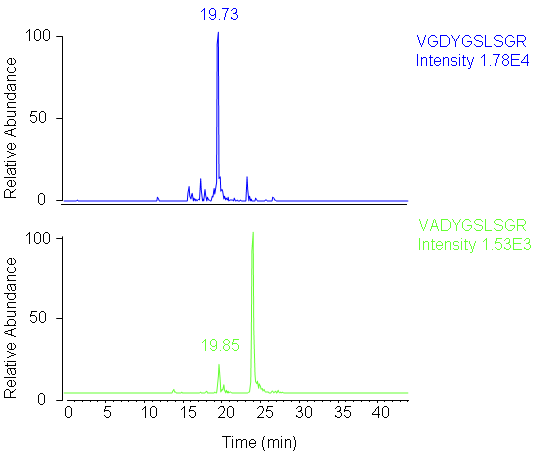
2.7 LC-MRM Analysis of Biological and Standard Peptides Illustrates Elution Times
2.8 Pseudo MS/MS Comparison of Transition Patterns for Biological/Standard Peptides
