Information for Peptide: HLQLAIR from H2A1A_HUMAN
1. Biological Peptide
1.1 Native Sequence
R.HLQLAIR.N
1.2 Peptide Properties
| Start | Stop | MW | m/z for 2+ | m/z for 3+ | pI |
|---|---|---|---|---|---|
| 83 | 89 | 849.52 | 425.77 | 284.18 | 9.76 |
1.3 Fragment Ion Table
| AA | b Ion Series | b Ion Mass | y Ion Series | y Ion Mass |
|---|---|---|---|---|
| H | b | y | ||
| L | b | y | ||
| Q | b | y | ||
| L | b | y | ||
| A | b | y | ||
| I | b | y | ||
| R | b | y |
2. Synthetic Peptide
2.1 Synthetic (Internal Standard) Peptide Sequence
HLQL(C5N1)AIR (Modification: Stable isotope on L4 (U-13C, 15N) )
2.2 Peptide Properties
| MW | m/z for 2+ | m/z for 3+ | pI |
|---|---|---|---|
| 855.53 | 428.77 | 286.19 | 9.76 |
2.3 Fragment Ion Table
| AA | b Ion Series | b Ion Mass | y Ion Series | y Ion Mass |
|---|---|---|---|---|
| H | b | y | ||
| L | b | y | ||
| Q | b | y | ||
| L | b | y | ||
| A | b | y | ||
| I | b | y | ||
| R | b | y |
2.4 Peptide Synthesis Report
 Click to view/download synthesis report for HLQLAIR
2.5 QqQ MS/MS
Transition Table:
| Transition | m/z of Transition | Collision Energy |
|---|---|---|
| b3 | 379.20942 | 21.0 |
| b4 | 479.32479 | 21.0 |
| b5 | 570.3306 | 18.0 |
| b6 | 683.41466 | 14.0 |
| y3 | 359.24072 | 21.0 |
| y4 | 499.29349 | 21.0 |
| y5 | 607.38336 | 19.0 |
| y6 | 720.46743 | 21.0 |
2.6 Calibration Curve of Standard
Description: NONE
Experiment Description: Cells from line 8226 were lysed in 8M urea/100mM ammonium bicarbonate and then were subjected to in-solution digestion with trypsin, following reduction and alkylation. The digest was then diluted down to the equivalent of 500 cells and injected concurrently with internal standards into a Thermo Scientific TSQ mass spectrometer.
2.7 LC-MRM Analysis of Biological and Standard Peptides Illustrates Elution Times

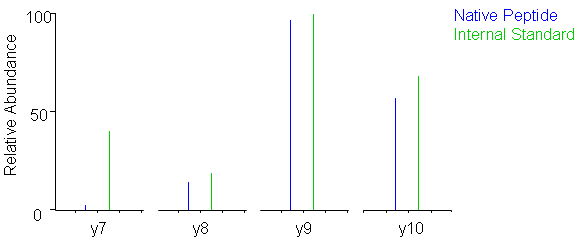
2.8 Pseudo MS/MS Comparison of Transition Patterns for Biological/Standard Peptides