

Information for Peptide: GLPAPIEK from IGHG2_HUMAN
1. Biological Peptide
1.1 Native Sequence
K.GLPAPIEK.T
1.2 Peptide Properties
| Start | Stop | MW | m/z for 2+ | m/z for 3+ | pI |
|---|---|---|---|---|---|
| 206 | 213 | 823.48 | 412.75 | 275.5 | 6.0 |
1.3 Fragment Ion Table
| AA | b Ion Series | b Ion Mass | y Ion Series | y Ion Mass |
|---|---|---|---|---|
| G | b | y | ||
| L | b | y | ||
| P | b | y | ||
| A | b | y | ||
| P | b | y | ||
| I | b | y | ||
| E | b | y | ||
| K | b | y |
2. Synthetic Peptide
2.1 Synthetic (Internal Standard) Peptide Sequence
GLPAP(C5N1)IEK (Modification: Stable Isotope on P5 (U-13C5, 15N) )
2.2 Peptide Properties
| MW | m/z for 2+ | m/z for 3+ | pI |
|---|---|---|---|
| 829.49 | 415.75 | 277.51 | 6.0 |
2.3 Fragment Ion Table
| AA | b Ion Series | b Ion Mass | y Ion Series | y Ion Mass |
|---|---|---|---|---|
| G | b | y | ||
| L | b | y | ||
| P | b | y | ||
| A | b | y | ||
| P | b | y | ||
| I | b | y | ||
| E | b | y | ||
| K | b | y |
2.4 Peptide Synthesis Report
 Click to view/download synthesis report for GLPAPIEK
2.5 QqQ MS/MS
Transition Table:
| Transition | m/z of Transition | Collision Energy |
|---|---|---|
| y4 | 492.293 | 17.0 |
| y5 | 563.33 | 17.0 |
| y6 | 660.383 | 17.0 |
2.6 Calibration Curve of Standard
Description: A dilution series was done on the internal standard from 50 fmol per injection down to 0.5 fmol per injection. The peptide was detectable down to the lowest values.
Experiment Description: Serum sample digest from healthy adult venous blood draw. Sample denatured in Urea, reduced and alkylated (20mM TCEP and 200mM IAA) and digested overnight with trypsin. Sample was diluted in 2% ACN with 0.1% formic acid and a total of 0.1 nanoliters of serum was injected onto column.
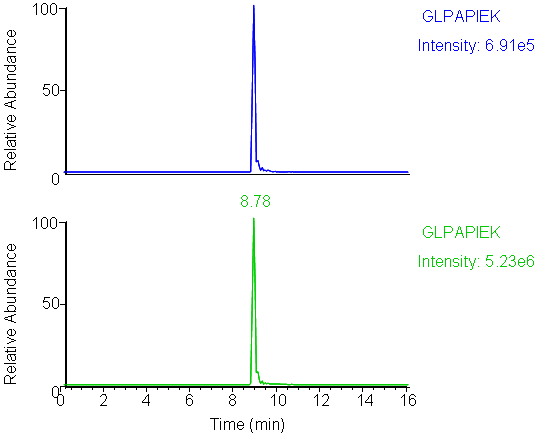
2.7 LC-MRM Analysis of Biological and Standard Peptides Illustrates Elution Times
2.8 Pseudo MS/MS Comparison of Transition Patterns for Biological/Standard Peptides
