Information for Peptide: ELGTLIPK from MITF_HUMAN
1. Biological Peptide
1.1 Native Sequence
K.ELGTLIPK.S
1.2 Peptide Properties
| Start | Stop | MW | m/z for 2+ | m/z for 3+ | pI |
|---|---|---|---|---|---|
| 333 | 340 | 869.52 | 435.77 | 290.85 | 6.1 |
1.3 Fragment Ion Table
| AA | b Ion Series | b Ion Mass | y Ion Series | y Ion Mass |
|---|---|---|---|---|
| E | b | y | ||
| L | b | y | ||
| G | b | y | ||
| T | b | y | ||
| L | b | y | ||
| I | b | y | ||
| P | b | y | ||
| K | b | y |
2. Synthetic Peptide
2.1 Synthetic (Internal Standard) Peptide Sequence
ELGTLIP(C5N1)K (Modification: Stable isotope added to P7 (13C, 15N) )
2.2 Peptide Properties
| MW | m/z for 2+ | m/z for 3+ | pI |
|---|---|---|---|
| 875.54 | 438.78 | 292.85 | 6.1 |
2.3 Fragment Ion Table
| AA | b Ion Series | b Ion Mass | y Ion Series | y Ion Mass |
|---|---|---|---|---|
| E | b | y | ||
| L | b | y | ||
| G | b | y | ||
| T | b | y | ||
| L | b | y | ||
| I | b | y | ||
| P | b | y | ||
| K | b | y |
2.4 Peptide Synthesis Report
 Click to view/download synthesis report for ELGTLIPK
2.5 QqQ MS/MS
Transition Table:
| Transition | m/z of Transition | Collision Energy |
|---|---|---|
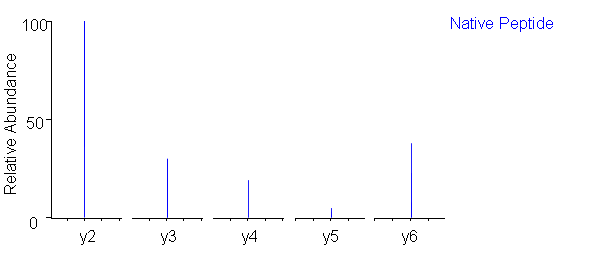
| y7 | 747.48749 | 17.0 |
| y6 | 634.40343 | 16.0 |
| y5 | 577.38197 | 16.0 |
| y4 | 476.33429 | 15.0 |
| y3 | 363.25022 | 14.0 |
| y2 | 250.16616 | 17.0 |
2.6 Calibration Curve of Standard
Description: A dilution series was done on the internal standard peptide from 50 Fmol to 0.1 fmol. Peptide detection was possible to 0.5 fmol.
Experiment Description: Cells from Melanoma cell lineS were lysed in 8M urea/100mM Ammonium bicarbonate buffer. The equivalent of 200,000 cells were loaded onto an SDS gel.
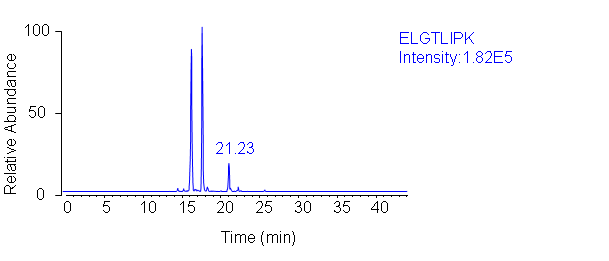
2.7 LC-MRM Analysis of Biological and Standard Peptides Illustrates Elution Times
2.8 Pseudo MS/MS Comparison of Transition Patterns for Biological/Standard Peptides